
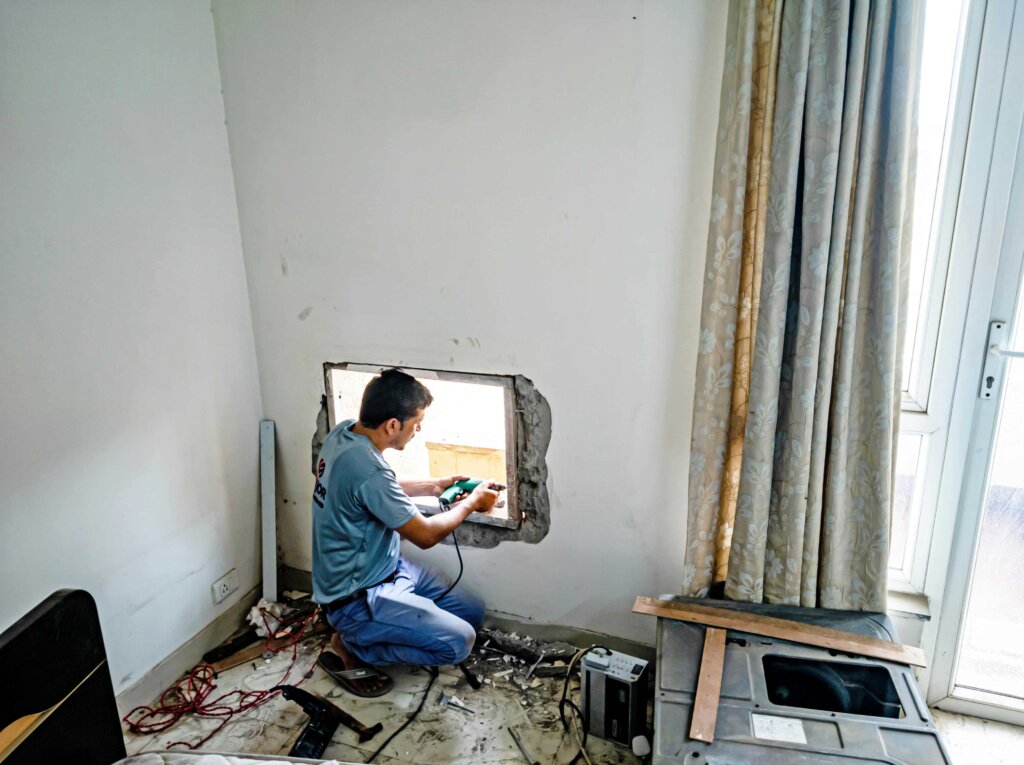
If You’re Dealing With an Emergency Right Now
- Document the condition. Take photos with timestamps. For AC failure, photograph a thermometer showing the indoor temperature.
- Send written notice to your landlord today. A dated letter describing the problem, delivered to whoever collects your rent. Certified mail is strongest, but email or text creates a record while you get the letter out.
- If the condition is dangerous (no AC with elderly or children present, sewage backup, major water intrusion), call Austin 3-1-1 to file a code complaint. You can report anonymously.
- Keep paying rent. Texas does not allow rent withholding. Falling behind on rent eliminates your legal protections. Pay rent, document everything, pursue formal remedies.
The rest of this guide explains the law behind each step, what your landlord is required to do, and exactly how to escalate if they don’t.
Your AC went out last night. It’s already 92° inside your apartment. Or you pulled back the shower curtain and found black mold creeping up the bathroom wall. Or you turned on the kitchen light at 2 a.m. and watched roaches scatter across the counter.
Now you’re googling your rights — and finding a maze of legal jargon, generic national articles, and contradictory advice.
We help hundreds of Austin renters through the apartment search and leasing process every year, and these three issues (AC failure, mold, and pest infestations) are the complaints we hear about most. Austin’s climate creates ideal conditions for all three: extreme heat that breaks HVAC systems, humidity that breeds mold, and year-round warmth that keeps pest populations thriving.
This guide covers what Texas law actually requires your landlord to do, what Austin-specific rules apply (including a 2025 indoor temperature standard most renters don’t know about), and the exact steps you should take right now to protect your health and your legal standing.
The Legal Framework: Texas Property Code §92.052
Every habitability issue in Texas starts with the same statute. Section 92.052 of the Texas Property Code requires landlords to make a diligent effort to repair or remedy any condition that materially affects the physical health or safety of an ordinary tenant.
That’s the standard. Not “any condition that annoys you.” Not “any condition that makes the apartment less comfortable.” The condition has to affect health or safety. Broken AC in August qualifies. A squeaky door doesn’t.
Four things must be true before your landlord has a legal repair obligation:
- The condition wasn’t caused by you, your family, or your guests (normal wear and tear is an exception — if the AC unit fails from age, that’s on the landlord, not you)
- You’ve given notice to the person or place where you normally pay rent
- You aren’t behind on rent at the time you give notice
- The landlord hasn’t been given an unreasonably short time to repair
That third point is critical. If you’re delinquent on rent when you report the issue, you lose your statutory protections. Pay your rent, even if the apartment has problems. We know that feels counterintuitive. But in Texas, rent withholding without a court order will get you evicted faster than mold will.
⚠️ Do not withhold rent. This is one of the most common mistakes Texas renters make. You cannot stop paying rent because your landlord won’t make repairs, even if the condition is serious. If you withhold rent, you lose your rights under the Property Code, and your landlord can begin eviction proceedings. Worse, under §92.058, the landlord can sue you for one month’s rent plus $500 and attorney’s fees. Continue paying rent while you pursue the formal remedies described in this guide.
Written Notice: Your Single Most Important Step
Written notice is the foundation of every tenant remedy in Texas. Without it, you have no legal standing. The right to repairs guide on TexasLawHelp.org walks through the full notice process, but here’s the short version.
A dated letter sent by certified mail, return receipt requested, is the strongest form of notice. That creates a legal paper trail the landlord can’t dispute. But the law also recognizes other forms, and in an emergency, you don’t want to wait three days for certified mail to arrive.
| Notice Method | Legal Strength | Speed | Key Detail |
|---|---|---|---|
| Certified mail, return receipt | Strongest (only requires ONE notice) | 2-3 days delivery | Keep the receipt. One notice triggers full statutory remedies |
| Hand delivery to landlord/manager | Strong (but requires TWO notices) | Immediate | Wait at least 7 days between notices. Get a witness or written acknowledgment |
| Email to management | Moderate (creates a timestamp) | Immediate | Save copies. Some courts accept it, some don’t. Best as a supplement to certified mail |
| Text message | Moderate (creates a timestamp) | Immediate | Screenshot and save. Same limitations as email |
| Maintenance portal / work order | Weakest for statutory purposes | Immediate | Good for starting the repair process, but may not satisfy the formal notice requirement. Follow up in writing |
Source: Texas Property Code §92.056
One distinction trips up a lot of renters: certified mail requires only one notice before your statutory remedies kick in. Every other delivery method (hand delivery, email, text) requires two notices separated by a reasonable period, typically 7 days. If you can, send certified mail. It saves you a step.
What to do right now: Send written notice today. Even if you already called maintenance, follow up with a dated letter or certified mail. Include the date, your name and unit number, a specific description of the condition, and a request for repair within a reasonable time.
AC Failure in Austin: When Heat Becomes a Health Hazard
Most renters don’t realize this: Texas has no state law specifically requiring landlords to provide air conditioning. That sounds absurd in a state where summer temperatures routinely clear 100°. But the protection comes from a different angle.
The Texas Tenants’ Rights Handbook, published by the State Bar of Texas, lists a lack of heat or air conditioning as an example of a condition that materially affects the health and safety of an ordinary tenant. So a broken AC unit, in an apartment that came with AC, falls under the §92.052 repair obligation. Your landlord doesn’t have to install AC where it never existed. But if the lease includes it — and virtually every Austin apartment lease does — they have to keep it working.
Austin’s New Indoor Temperature Standard
This is the part most people haven’t heard about yet.
On July 10, 2025, the City of Austin amended its Property Maintenance Code to require that all homes, including apartments and rentals, must be able to keep indoor air no hotter than 85°F and at least 15 degrees cooler than outside temperature. The rule doesn’t specify what equipment is needed (portable units and window ACs count), but the cooling standard must be met.
That’s a big shift. Before this, Austin renters relied on the general “health and safety” standard, which was hard to pin down. Now there’s a measurable threshold: 85°F indoors. If your apartment can’t maintain that, you have a code violation on top of your Property Code rights.
The Austin Apartment Association published compliance guidance noting that enforcement is complaint-driven, meaning you need to report a violation for it to be investigated. Call Austin 3-1-1 or submit a complaint through the Austin 3-1-1 app or website to start that process.
The AC Repair Timeline
The HVAC repair-and-deduct provision in Texas Property Code §92.0561 has a specific and accelerated timeline that differs from the general 7-day standard:
| Day | What Happens | What You Do |
|---|---|---|
| Day 0 | AC fails | Submit a maintenance request AND written notice (dated, specific). Document interior temperature with a thermometer photo that shows the reading and a timestamp |
| Day 1-3 | Landlord’s window to begin repair under HVAC provision | If landlord has agreed to provide cooling and a local health/building official confirms the condition, landlord has 3 days to act |
| Day 7 | General “reasonable time” threshold | If no action, send second written notice (if first wasn’t certified mail). State you will pursue remedies if the condition isn’t addressed |
| Day 7+ | Escalation | Options: repair-and-deduct (strict requirements apply), lease termination (must give notice), code complaint with Austin 3-1-1, or repair and remedy lawsuit in Justice of the Peace court |
Source: Texas Property Code §92.0561, §92.056
A few things worth noting about that 3-day timeline. It has a condition most renters miss: a local health, housing, or building official must give the landlord written notice that the lack of cooling affects health or safety. That means you may need to file a code complaint with Austin 3-1-1 first, which triggers an inspection. If the inspector confirms the violation, that creates the official notice the statute requires.
If you have elderly residents, young children, or anyone with a health condition in the unit, emphasize this when filing. Heat-related illness is a medical emergency, not an inconvenience.
Dealing with a complex dispute with management, or unsure about the repair-and-deduct process? Give us a call at 512-360-0852. We can’t provide legal advice, but we can help you understand your options and connect you with the right resources.
What to do right now: Document the interior temperature with a timestamped photo. Submit written notice immediately. If the temperature is dangerous (especially for vulnerable residents), call Austin 3-1-1 today to file a code complaint.
Mold in Your Austin Apartment: What the Law Requires
Texas has no statute that specifically addresses mold in residential rentals. No mold disclosure law. No mold inspection requirement. No specific remediation timeline. The TexasLawHelp.org mold guide confirms this gap.
But that doesn’t mean you’re unprotected.
Mold that affects health or safety falls under the same §92.052 habitability standard as everything else. If mold in your apartment is causing respiratory issues, allergic reactions, or other health problems, your landlord has a duty to address it, provided you follow the proper notice procedure.
What makes mold cases tricky is proving the connection between the mold and a health impact. A broken AC speaks for itself (the thermometer doesn’t lie). Mold requires documentation. And the more documentation you have, the stronger your position.
What Austin Code Compliance Can and Cannot Do
An important distinction most renters miss: Austin’s DSD Code Compliance does not conduct mold inspections or testing. They don’t regulate mold assessors or remediators either. That responsibility sits at the state level with the Texas Department of Licensing and Regulation (TDLR).
What Code Compliance CAN address are the conditions that cause mold:
- Improper weatherization (unsealed windows or door frames)
- Water leaks from AC units, sink pipes, or roofs
- Ventilation problems that trap moisture
If your mold problem stems from a persistent leak or poor ventilation, a code complaint can put official pressure on your landlord to fix the underlying cause. The mold itself is a separate remediation issue, but cutting off the moisture source is step one.
Painting Over Mold Is Not Remediation
We need to be direct about this. If your landlord’s response to a mold report is to send someone with a can of Kilz to paint over the affected area, that is not a repair. That is a cosmetic cover-up. It does not address the mold colony behind the paint, the moisture source feeding it, or the spores already in the air.
Proper remediation requires a licensed professional — Texas law requires anyone performing mold assessment or mold remediation to hold a state license from TDLR. If your landlord sends an unlicensed maintenance worker to “clean up” visible mold, that may not satisfy their repair obligation. And the mold will come back.
You can verify whether a mold assessor or remediator is licensed through the TDLR license search tool.
Mold Documentation Checklist
| What to Document | How | Why It Matters |
|---|---|---|
| Visible mold location and extent | Photographs with date stamps; include a ruler or coin for scale | Proves the condition existed and its severity |
| Water damage or moisture source | Photos of leaks, stains, condensation, peeling paint | Connects mold to a maintenance failure, not tenant behavior |
| Health symptoms | Medical records, doctor visit notes, dates symptoms began | Strengthens your case that the condition affects health/safety |
| Written notice to landlord | Copy of letter, certified mail receipt, email/text screenshots | Proves you followed the statutory notice requirement |
| Landlord’s response (or lack thereof) | Save all correspondence, note dates of maintenance visits, photograph any “repairs” | Builds timeline showing whether landlord made “diligent effort” |
| Indoor air quality test (optional) | Hire a TDLR-licensed mold assessment consultant | Provides objective evidence. Note: the assessor must notify the landlord before testing per TDLR rules |
If you pursue a repair-and-deduct remedy for mold, the Texas Property Code requires a local housing, building, or health official to give the landlord written notice that the condition affects health or safety. Same requirement as the HVAC provision. You may need to file a code complaint first.
What to do right now: Photograph every mold location today with date-stamped images. Send written notice to your landlord specifying exactly where the mold is. If you have respiratory symptoms or allergic reactions, schedule a doctor visit and keep the records. Do not attempt to clean large areas of mold yourself; you can spread spores.
[INTAKE FORM: “Need Help Finding a Better Austin Apartment?”]
Pest Infestations: Roaches, Bed Bugs, and Rodents
Austin’s warm, humid climate makes it one of the most pest-active metro areas in Texas year-round. Cockroaches, bed bugs, and rodents are the three most common complaints we hear from renters, and each one has different legal dynamics.
Cockroaches and Rodents
These fall squarely under the habitability standard. The Texas Tenants’ Rights Handbook specifically lists roaches and rats as examples of conditions that materially affect health and safety. If your apartment has a cockroach or rodent infestation, your landlord has a repair obligation under §92.052.
The question is who caused the problem.
Pre-existing infestations — roaches that were there before you moved in, rodents entering through structural gaps the landlord hasn’t sealed — are the landlord’s responsibility. If the infestation results from a tenant’s failure to maintain the unit, like leaving food out or not disposing of trash properly, some or all of the responsibility may shift to the tenant.
In multi-unit apartments, this distinction gets complicated fast. Roaches travel through shared walls, plumbing chases, and utility connections. Your unit can be spotless and still get hit if an adjacent unit has an infestation. That’s a building-level problem the landlord needs to address, not something an individual tenant caused.
Bed Bugs: The Gray Area
Bed bugs are the most legally complicated pest issue in Texas. Unlike roaches and rodents, Texas law doesn’t clearly assign responsibility. A bill in 2021 (HB 3882) would have placed the inspection and treatment burden on landlords, but it died in committee and hasn’t been revived.
The current landscape:
- Most standard apartment leases in Texas include a bed bug addendum
- By signing the addendum, you’re typically agreeing the unit is bed-bug-free at move-in
- If bed bugs appear after you move in, the addendum can be used to argue the tenant introduced them
- The burden often falls on the tenant to prove they didn’t cause the infestation
That bed bug addendum is worth reading carefully before you sign. It’s one of those red flags worth catching before you commit to a lease. And a practical tip from what we’ve seen in the Austin market: inspect the unit within 48 hours of move-in. Check mattress seams, behind headboards, in furniture crevices, along baseboards, and behind outlet covers. If you find any evidence, document it immediately on your move-in inventory form and notify the landlord in writing the same day. This creates evidence that the infestation pre-existed your tenancy.
The TexasLawHelp.org bed bug fact sheet walks through the full addendum process and your options if bed bugs appear.
| Pest Scenario | Who’s Typically Responsible | What to Do |
|---|---|---|
| Cockroaches present at move-in | Landlord | Document on move-in inventory, submit written repair notice |
| Cockroaches in multi-unit building (shared-wall spread) | Landlord (building-level maintenance issue) | Written notice to landlord requesting building-wide treatment |
| Roaches/rodents caused by tenant not maintaining unit | Tenant (landlord may charge for treatment) | Clean and maintain unit; cooperate with pest control |
| Bed bugs found within 48 hours of move-in | Landlord (pre-existing infestation) | Immediately document on inventory form, send written notice |
| Bed bugs found months after move-in (addendum signed) | Disputed (often falls on tenant to prove they didn’t cause it) | Document, send written notice, consider splitting treatment cost if responsibility is unclear |
| Rodents entering through structural gaps | Landlord (structural maintenance issue) | Written notice specifying entry points, request structural repair plus extermination |
Source: Texas Property Code §92.052; TexasLawHelp.org bed bug fact sheet
Bed bug treatment costs vary widely. Chemical treatment typically runs $200-$600 per room. Whole-unit heat treatment, which is more effective for severe infestations, ranges from $1,500 to $4,000 depending on unit size. Multiple treatments are often needed, and costs climb fast in multi-room infestations. If you and your landlord can’t agree on who’s responsible, the TexasLawHelp.org fact sheet suggests splitting the cost while disputing responsibility. It gets the bugs out while the liability question gets sorted.
If you’re dealing with a bed bug dispute that’s going nowhere, call us at 512-360-0852. We can help you understand your options and potentially help you find a new apartment if you need to move quickly.
What to do right now: Identify the pest, photograph evidence, check your lease for pest control provisions, and send written notice to your landlord with specific details about the type of pest, where you found it, and when.
Your Legal Remedies When the Landlord Won’t Act
You’ve sent proper written notice. You’ve given a reasonable time. Your landlord still hasn’t fixed the problem.
Now what?
Texas law gives you three main remedies. But each one comes with requirements, and getting any of them wrong can backfire.
Option 1: Repair-and-Deduct
Under Texas Property Code §92.0561, you can hire someone to fix the problem yourself and deduct the cost from your next rent payment. The requirements are strict:
- You must have given proper written notice and waited a reasonable time
- For HVAC and conditions where a local official has confirmed the health/safety impact, the landlord gets 3 days after your notice of intent to repair
- The deduction can’t exceed the greater of one month’s rent or $500 in any given month
- The repair must be done by a qualified professional (not you with a YouTube tutorial)
- You can’t use this remedy if you waived it in an enforceable lease provision
The math in practice: Say your rent is $1,600/month and the AC repair costs $900. Your deduction cap is $1,600 (the greater of one month’s rent or $500). You can deduct the full $900 from your next rent payment, so you’d pay $700 that month. But if the repair costs $2,200, you can only deduct $1,600 in the first month. The remaining $600 would come off the following month’s rent. And if your rent is only $450/month, your cap is $500 (the greater of the two), so a $900 repair would take two months of deductions.
Get this wrong — deduct too much, skip the notice requirement, or fix a condition not covered by the statute — and the landlord can sue you for actual damages, one month’s rent plus $500, and attorney’s fees under §92.058. That’s not an empty threat.
Option 2: Lease Termination
If the condition isn’t repaired after proper notice, you may be entitled to terminate your lease. You must include in your second written notice (or your certified mail notice) that you intend to terminate unless the condition is repaired within a reasonable time.
This gets you out of the lease without penalty, and you’re entitled to a refund of rent for the period after termination, plus your security deposit minus any lawful deductions. But if a court later determines you terminated improperly, the landlord could argue you’re still liable for the remaining lease term. If you’ve experienced job loss or another financial disruption that compounds the habitability issue, understanding your termination rights is especially important. [INTERNAL LINK PLACEHOLDER: security deposit law article when published]
Option 3: Repair and Remedy Lawsuit
You can file suit in the Justice of the Peace court (small claims court) to force the landlord to make repairs. The court can order:
- The landlord to make the repairs
- Your rent reduced from the date you first requested repairs until the problem is fixed
- One month’s rent plus $500 in damages
- Actual damages caused by the failure to repair
- Court costs and attorney’s fees
No attorney needed. Claims are limited to $20,000 (plus court costs and interest), and the court can hear your case in as few as 10 days after you file. The Texas Justice Court Training Center has repair and remedy forms available.
| Remedy | Requirements | Risk Level | Best For |
|---|---|---|---|
| Repair-and-deduct | Proper notice, reasonable time, local official confirmation (for some conditions), qualified repair, deduction limit | Medium (doing it wrong triggers landlord penalties against you) | Specific, fixable problems where cost is within the monthly cap |
| Lease termination | Proper notice stating intent to terminate, reasonable time | Medium-High (landlord may dispute whether you had the right to terminate) | Severe conditions where you need to leave |
| Court order (repair and remedy) | Proper notice, reasonable time elapsed, file in JP court | Lower (court process is structured and affordable) | When you want to stay but need the landlord compelled to act |
| Code complaint (supplemental) | Call Austin 3-1-1 or file online | Low (anonymous reporting available, retaliation protections apply) | Any situation (creates official record and can trigger inspection) |
Source: Texas Property Code §§92.056, 92.0561, 92.0563, 92.058
What You Cannot Do: Withhold Rent
This bears repeating because it’s the single most common mistake. You cannot simply stop paying rent because your landlord won’t make repairs. Texas doesn’t allow rent withholding as a self-help remedy. If you withhold rent, you lose your statutory protections, and your landlord can begin eviction proceedings. Even with a perfectly valid repair complaint, falling behind on rent gives the landlord the upper hand.
Pay your rent. Document the problems. Pursue the remedies above.
What to do right now: If your landlord has ignored written notices, consult with an attorney before choosing a remedy. Free and low-cost legal help is available through Lone Star Legal Aid (1-800-733-8394), the Austin Tenants Council (512-474-1961), and Texas RioGrande Legal Aid’s BASTA project for organizing collective tenant action.
Austin Code Enforcement: How to File and What Happens Next
Filing a code complaint is one of the lowest-risk actions a tenant can take. It’s also one of the most effective at putting official pressure on an unresponsive landlord.
If you live within Austin city limits: Call 3-1-1 (or 512-974-2000 from outside the city), use the Austin 3-1-1 smartphone app, or submit a complaint online. You can report anonymously.
If you live in unincorporated Travis County: The process goes through Travis County Development Services, which has a separate complaint portal.
After you file:
- A service request is created and assigned to a code inspector
- The inspector investigates, which may include a visit to your unit
- If a violation is confirmed, the inspector issues a Notice of Violation (NOV) to the property owner
- The NOV includes a list of violations, corrective actions needed, and a timeline for compliance
- If the property owner doesn’t resolve the violation within the timeframe, they may receive a citation
Retaliation Protection
Filing a code complaint is legally protected under Texas Property Code §92.331. Your landlord cannot retaliate against you for filing a complaint in good faith for six months from the date of your complaint. Retaliation includes eviction, lease termination, rent increases (unless already scheduled), or reducing services.
If you believe your landlord is retaliating, document every action and consult with an attorney. Penalties for landlord retaliation can include one month’s rent plus $500, actual damages, court costs, and attorney’s fees. [INTERNAL LINK PLACEHOLDER: unenforceable lease clauses article when published]
| Resource | Contact | What They Do |
|---|---|---|
| Austin 3-1-1 | 3-1-1 (or 512-974-2000) | Code violation reports, complaint tracking |
| Austin Tenants Council | 512-474-1961 | Tenant counseling, dispute mediation, repair packet |
| BASTA (Texas RioGrande Legal Aid) | bastaaustin.org | Collective tenant organizing, code complaint support |
| Travis County Development Services | traviscountytx.gov | Complaints for properties outside Austin city limits |
| Texas Attorney General — Tenant Rights | texasattorneygeneral.gov | Statewide tenant rights information, complaint filing |
| Lone Star Legal Aid | 1-800-733-8394 | Free legal representation for qualifying tenants |
| TexasLawHelp.org | texaslawhelp.org | Self-help legal guides, repair request templates, bed bug fact sheet |
How Property Class Affects Your Experience
Not every landlord repair dispute plays out the same way. A lot depends on what type of apartment community you’re in, and knowing where you stand helps you pick the right approach from day one.
Class A (luxury and newer construction): These properties typically have 24/7 emergency maintenance lines, professional property management companies, and maintenance teams on staff. AC breaks? Usually a same-day or next-day response. Your move: The standard work order system is probably enough. Submit the request, follow up by email the next day if you haven’t heard back. You’re paying premium rent, and the management company knows delayed maintenance drives turnover they can’t afford. If you’re looking at Downtown Austin apartments or newer North Austin properties near The Domain, most fall into this category.
Class B (mid-range, typically 10-25 years old): Mixed results. Larger management companies generally respond within 48-72 hours for non-emergency issues. Smaller operators or properties transitioning between owners can be slower. Your move: Submit the work order AND send a follow-up email the same day. If no response in 48 hours, send formal written notice by certified mail. Don’t assume it’s being handled.
Class C (older inventory, value-priced): This is where the formal notice process matters most. Class C properties often have smaller maintenance teams, tighter repair budgets, and management that may prioritize differently. Mold, pest, and HVAC issues are also more common in older buildings with aging infrastructure. Your move: Send certified mail on day one. Don’t rely on phone calls or portal requests alone. If you’re in a Class C property facing a habitability issue, follow the statutory process from the start and document everything.
Market context that works in your favor regardless of property class: Austin’s apartment vacancy rates currently sit between 9.9% and 15% depending on the submarket. That’s well above the 5-7% range that signals a healthy market. Properties across all classes are competing for tenants. A landlord who lets a habitability issue drag on risks losing a renter in a market where filling that vacancy could take weeks, plus the concessions needed to attract a replacement. That’s real negotiating power, and you should use it (politely but firmly). See how current pricing and concessions compare across Austin’s neighborhoods to understand exactly where you stand.
Frequently Asked Questions
Can I withhold rent if my landlord won’t make repairs in Texas?
No. Texas does not allow tenants to withhold rent as a self-help remedy. If you stop paying, you lose your statutory protections under the Property Code and your landlord can begin eviction proceedings, plus sue you for one month’s rent plus $500 and attorney’s fees under §92.058. You must continue paying rent while pursuing other remedies like repair-and-deduct, lease termination, or a court order. [INTERNAL LINK PLACEHOLDER: unenforceable lease clauses article when published]
How long does a landlord have to fix broken AC in Texas?
The law presumes 7 days is a reasonable time for most repairs. For HVAC specifically, if a local health or building official has confirmed the condition affects health or safety, the repair-and-deduct timeline shortens to 3 days under §92.0561. In practice, most large Austin apartment communities aim for 24-48 hours on AC repair requests during summer. But you need written notice on file in case they don’t follow through.
Does my landlord have to test for mold in Texas?
No. Texas has no law requiring landlords to inspect for or test for mold. They must address mold that affects health and safety once they’ve received written notice, but proactive testing is not required. If you want testing done, you can hire a TDLR-licensed mold assessment consultant, though the assessor is required to notify the landlord before performing services. [INTERNAL LINK PLACEHOLDER: tenant rights pillar when published]
Who pays for bed bug treatment in a Texas apartment?
It depends on who caused the infestation. Bed bugs present before you moved in? Landlord’s responsibility. If you introduced them (and a signed bed bug addendum shows the unit was clear at move-in), you may be responsible. When responsibility is unclear, which is common, some tenants and landlords agree to split the cost. Texas law doesn’t clearly assign bed bug responsibility, so your lease terms often control. The TexasLawHelp.org bed bug fact sheet has the most complete breakdown of your options.
Can my landlord evict me for reporting code violations?
No. Texas Property Code §92.331 prohibits landlord retaliation for filing good-faith complaints with government entities responsible for building or housing code enforcement. This protection lasts six months from the date of your complaint. If your landlord retaliates, you may be entitled to one month’s rent plus $500, actual damages, court costs, and attorney’s fees.
What counts as written notice for repairs in Texas?
A dated letter describing the condition that needs repair, delivered to the person or place where you normally pay rent. Certified mail with return receipt is the strongest method: it only requires one notice before statutory remedies kick in. All other delivery methods (hand delivery, email, text) require two notices with a reasonable period between them, typically 7 days.
Can I break my lease if my apartment has mold?
Potentially, yes. But only after following the statutory process. You must give proper written notice, wait a reasonable time for the landlord to act, and include in your notice that you intend to terminate if the condition isn’t remedied. Walking out without following these steps? The landlord could argue you’re still liable for the remaining lease term. Consult an attorney before terminating. [INTERNAL LINK PLACEHOLDER: security deposit law article when published]
What temperature does my Austin apartment have to be?
As of July 2025, Austin’s Property Maintenance Code requires that homes (including rentals) keep indoor air no hotter than 85°F and at least 15 degrees cooler than the outside temperature. Portable and window AC units can satisfy this requirement. If your apartment can’t meet this standard, file a complaint with Austin 3-1-1. [INTERNAL LINK PLACEHOLDER: natural disaster piece when published]
How do I file a code complaint in Austin?
Three ways: call Austin 3-1-1 (or 512-974-2000 from outside city limits), use the Austin 3-1-1 smartphone app, or submit online at austintexas.gov. You can report anonymously. For properties in unincorporated Travis County, complaints go through Travis County Development Services.
Can I sue my landlord for not making repairs in Texas?
Yes. You can file a repair and remedy lawsuit in the Justice of the Peace court. No attorney needed, claims are limited to $20,000, and the court can hear your case in as few as 10 days. The Texas Justice Court Training Center has forms available. The court can order repairs, reduce your rent, and award one month’s rent plus $500, actual damages, court costs, and attorney’s fees.
Is painting over mold considered a proper repair in Texas?
No. Painting over mold covers the visible growth but does nothing about the colony behind the paint, the moisture source, or airborne spores. Texas requires mold assessment and remediation professionals to be licensed by TDLR. If your landlord’s only response is to paint over mold, document it and send another written notice specifying that the condition has not been repaired.
The Bottom Line on Habitability in Austin
Texas law gives renters real protections against uninhabitable conditions. But those protections only work if you follow the correct process. Every right you have under the Property Code depends on written notice, current rent payments, and documentation.
The pattern is the same whether it’s broken AC, mold, or pests — document the condition, send written notice, give reasonable time, then escalate through the proper channels if the landlord doesn’t act. Skip any step and you risk losing your legal standing entirely.
Austin’s current rental market gives tenants more negotiating power than usual. Vacancy rates are elevated. Landlords are competing for tenants. Most management companies will address legitimate habitability issues, especially when they receive formal written notice. The formal process isn’t about being adversarial. It’s about creating the documentation that protects you if things don’t go well.
If you’re dealing with a habitability issue and need help finding a better-maintained apartment in Austin, the Austin Apartment Team can help. Our search tool ranks properties by net effective rent so you can see the actual cost, and we can help you navigate the apartment search process from start to finish. Call us at 512-360-0852 or fill out our intake form to get started. Our service is free to renters.
This article is for informational purposes only and does not constitute legal advice. Tenant rights and landlord obligations involve complex legal questions that depend on specific facts and circumstances. Consult with a qualified attorney before taking legal action. For free or low-cost legal assistance, contact the Austin Tenants Council (512-474-1961), Lone Star Legal Aid (1-800-733-8394), or visit TexasLawHelp.org.
